

 GET A QUOTE
Standard or Custom Machine? What to Discuss With a Drilling Machine Manufacturer in India
4 November, 2026

Powering Industries with Precision Engineering
4 November, 2026
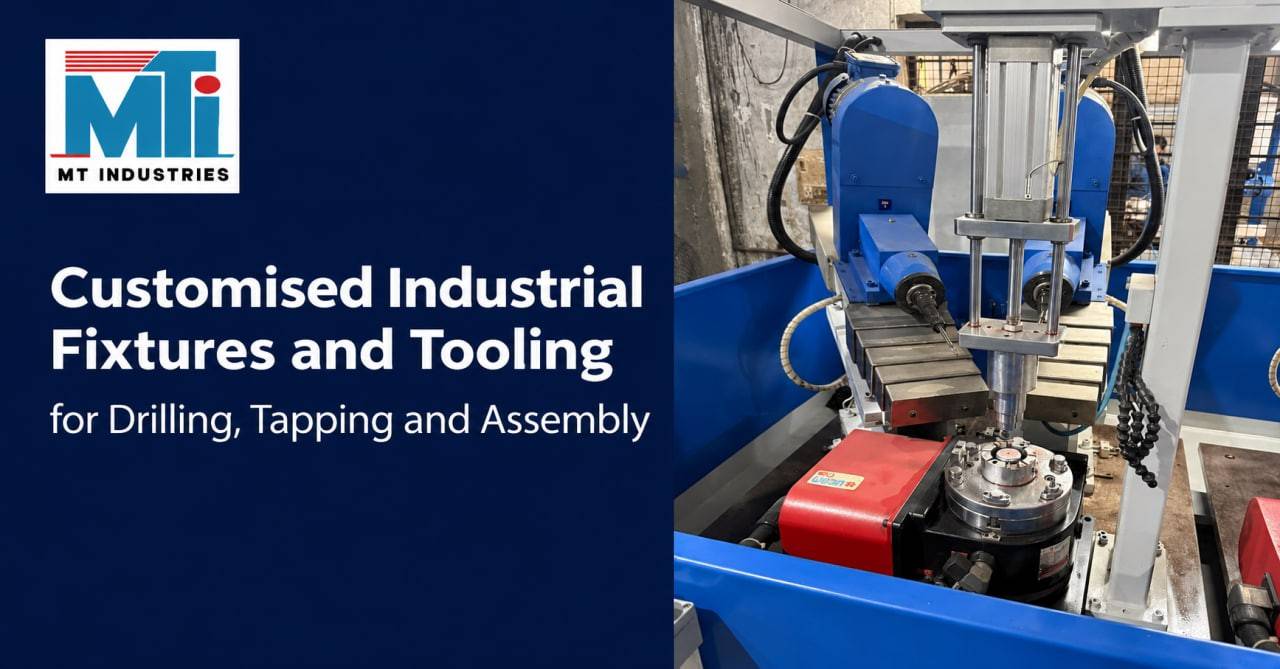
Ask any production engineer what decides quality on a machining line, and many will point to the fixture. The machine may be accurate and the tool sharp, but if the component sits even slightly differently each time, the result will not repeat. Industrial fixtures and tooling are the quiet foundation of every drilling, tapping and assembly operation. Customised Industrial Fixtures and Tooling, built around your exact component, give the stability and repeatability that general-purpose clamping cannot.
MT Industries designs and builds fixtures and tooling that work together with its SPM machines so that accuracy is planned from the first drawing.
A fixture is a work-holding device that locates, supports and clamps a component during an operation. Tooling includes the cutting and guiding elements around it, such as drill bushes, tap guides, special tool holders and gauges. Together they ensure that every part is positioned in the same place, held firmly against cutting forces and processed the same way. For SPM machine fixtures in particular, the fixture is part of the machine’s design rather than an add-on. A fixture that is too loose causes errors, while one that clamps too hard can distort thin or delicate parts.
Fixture design rests on a few core principles:
Drilling fixtures focus on hole position. They use hardened locating pins and guide bushes, and they allow chips and coolant to drain away freely.
Tapping fixtures hold the part rigidly against the axial force and torque of the tap, and align the hole with the spindle so that the thread starts straight.
Assembly fixtures, often called nests, hold parts in the exact relationship needed for pressing, screwing or testing, and often include sensors that confirm each part is present.
Fixture materials are chosen for strength, wear resistance and stability. Hardened tool steels are used for locating pins and bushes, mild or alloy steel for bodies and plates, and aluminium where weight matters. Surface finish, hardness and the grinding of contact surfaces all affect long-term accuracy. Well-made fixtures also allow easy cleaning and the replacement of worn parts, so the investment lasts.
Even the best fixture needs care. Clean locating faces and clamps after every shift, check bushes and pins for wear on a schedule, and replace them before they affect hole position. Periodic inspection of the fixture against a master component confirms that it still holds the part exactly where it should. Keeping a log of these checks helps spot gradual drift before it turns into scrap.
When you approach industrial fixtures manufacturers, bring the component drawing or 3D model, the material, the operations to be performed, the expected volumes and the way parts will be loaded. Mention the datum surfaces used in inspection, since the fixture should reference the same ones. A manufacturer who also builds SPM machines can design the fixture and the machine as one system.
MT Industries design and build special-purpose machines for industrial production. Its range covers drilling and tapping machines, multi-spindle heads, automated assembly systems and customised fixtures and tooling, all made around the customer’s component and output target. To discuss your requirement, visit mtindustries.in or contact the team through the website.
Can one fixture serve several component variants?
Yes, with modular elements or changeover plates, provided the variants share suitable datum features.
How long does a fixture last?
It depends on volume, material and maintenance. Wear parts such as bushes and pins are designed to be replaceable.
Is a custom fixture worth the cost?
For repeat production it usually is, because it reduces scrap, loading time and rework.
Can fixtures be built for machines I already own?
Yes, fixtures can be designed to suit the machines already on your floor.