

 GET A QUOTE
Standard or Custom Machine? What to Discuss With a Drilling Machine Manufacturer in India
4 November, 2026

Powering Industries with Precision Engineering
4 November, 2026
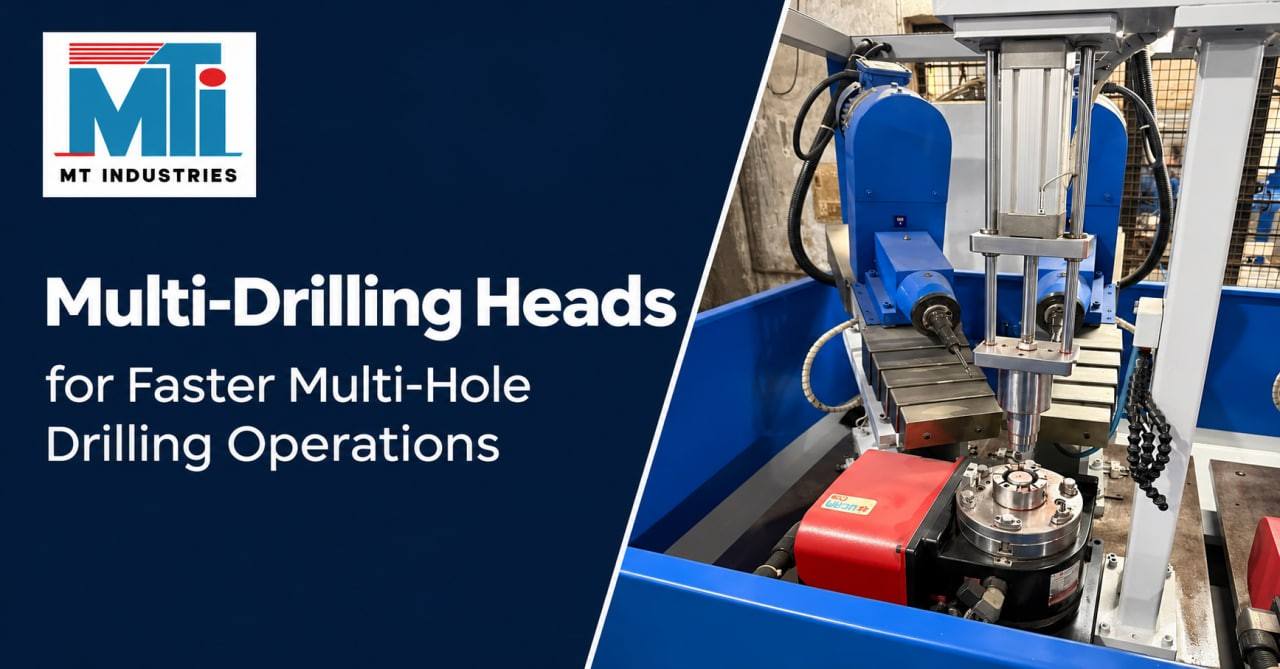
A cover plate with eight holes, a flange with twelve, a housing with holes on three faces: drilling each hole individually repeats the same movements again and again, and every repetition adds time and a chance for error. A Multi-Drilling Head changes that equation by drilling many holes together. For plants that produce the same multi-hole components in volume, it is one of the most effective ways to shorten the cycle and keep hole positions consistent.
MT Industries designs these heads as part of its SPM solutions, matched to the component, the material and the target output, so that the machine fits the job rather than the other way round.
It is a gearbox-type attachment that carries several spindles and is driven by a single main spindle or motor. Each output spindle holds a drill, and the spindles are arranged to match the hole pattern on the component. When the head is fed forward, all the drills cut at the same time. It can be mounted on a Multi-Head Drilling SPM, a drilling unit or a dedicated machine. Because the spindle positions are fixed by the head, hole spacing depends on the machine rather than on the operator.
The right type depends on how often the hole pattern is expected to change.
A Precision Multi-Drill Spindle is only as good as the parts inside the head. Hardened gears transfer power from the drive to each spindle, and precision bearings hold the spindles in line and absorb the axial thrust of drilling. A lubrication system protects gears and bearings, and coolant can be supplied through or around the drills to clear chips. Spindle run-out and alignment must be tightly controlled, because even a small error is multiplied across many drills.
The gains grow with every additional hole on the component.
Choosing the right head means matching it to the job:
Closely spaced holes or hard materials can limit how many drills a head can carry, so the design stage matters.
Regular lubrication, periodic checks on bearings and gears, and cleaning of chips from the head and fixture keep performance steady. Drills should be changed in sets and sharpened to the same standard so that all spindles cut evenly. Checking spindle run-out at intervals catches wear before it affects hole quality.
Typical applications include flanges, covers, brake parts, pump and valve bodies, motor housings and switchgear plates; anywhere several holes must be drilled in a fixed pattern at volume.
Final thoughts
MT Industries designs and builds special-purpose machines for industrial production. Its range covers drilling and tapping machines, multi-spindle heads, automated assembly systems and customised fixtures and tooling, all made around the customer’s component and output target. To discuss your requirement, visit mtindustries.in or contact the team through the website.
How many spindles can a head carry?
It depends on hole spacing, drill size and the drive power available. Closely spaced holes limit the number.
Can it drill holes of different diameters together?
Yes, provided the power, thrust and feed suit all the drills at once.
Can it handle blind and through holes?
Yes, with depth control built into the feed system.
What if my hole pattern changes?
An adjustable head can cover a limited range of patterns. Larger changes usually need a new head.
If you are drilling multi-hole components one hole at a time, MT Industries can recommend a head that fits your component and output target